Pearson Edexcel · A-Level · Economics B
Course version: 9EB0 · Version from Sept 2015
Barriers to entry: d) Economies of scale and their impact on cost and price
Economies of scale occur when a firm's long-run average costs fall as its scale of production increases.
Checked against the Pearson Edexcel 9EB0 specification (opens in a new tab) on .
- Point 4 of 4
- 2 key terms
Study notes
From the checked teaching notes for this specification point.
The idea
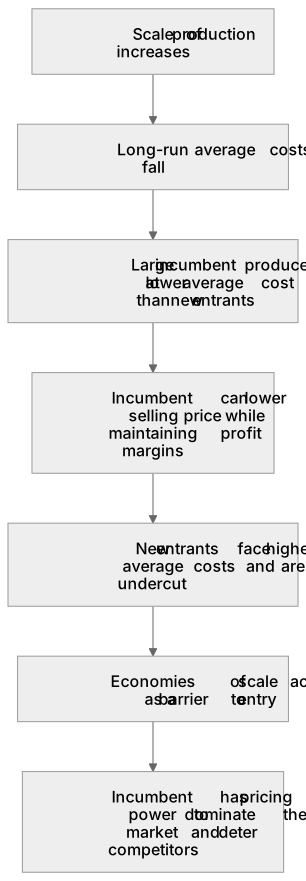
Economies of scale occur when a firm's long-run average costs fall as its scale of production increases. This acts as a significant barrier to entry because large incumbent firms can produce at a lower average cost than new, smaller entrants. For example, a massive car manufacturer benefits from technical economies by using expensive automated machinery, spreading fixed costs over millions of vehicles. This reduction in average cost allows the large firm to lower its selling price while maintaining profit margins, effectively undercutting new entrants who face higher average costs. Consequently, economies of scale dictate the cost structure of a business and give it the pricing power to dominate the market and deter potential competitors.
What earns the marks
- Define economies of scale as the reduction in long-run average costs as the scale of production increases.
- Explain how lower average costs enable firms to reduce prices, increasing their competitiveness and market share.
- Identify economies of scale as a structural barrier to entry that deters new firms unable to match the low costs of incumbents.
- Differentiate between internal economies of scale and their specific impacts on a firm's cost structure.
Common mistakes and how to put them right
Confusing economies of scale with increased total production.
Put it right: Economies of scale specifically refer to a fall in average unit costs, not just producing more goods.
Assuming economies of scale reduce total costs.
Put it right: Total costs increase as production rises, but the cost per unit or average cost falls.
Stating that economies of scale only benefit the producer.
Put it right: Consumers can also benefit if the firm passes on the lower average costs in the form of lower retail prices.
Exam tips
- Always specify average costs or unit costs rather than just costs when defining or discussing economies of scale.
- In multiple-choice questions, look for scenarios where a firm uses its lower average costs to aggressively price out new entrants, demonstrating a barrier to entry.
- Link specific types of economies of scale directly to how they reduce the firm's long-run average cost curve.
Try the lesson
The start of the Barriers to entry: d) Economies of scale and their impact on cost and price lesson, made from checked teaching notes for this specification point.
Have a go first
How do significant economies of scale in an industry primarily act as a barrier to entry for new firms?
Listen
Economies of scale occur when a firm's long-run average costs fall as its scale of production increases. This acts as a significant barrier to entry because large incumbent firms can produce at a lower average cost than new, smaller entrants. For example, a massive car manufacturer benefits from technical economies by using expensive automated machinery, spreading fixed costs over millions of vehicles. This reduction in average cost allows the large firm to lower its selling price while maintaining profit margins, effectively undercutting new entrants who face higher average costs. Consequently, economies of scale dictate the cost structure of a business and give it the pricing power to dominate the market and deter potential competitors. A strong answer earns marks for these points. Define economies of scale as the reduction in long-run average costs as the scale of production increases. Explain how lower average costs enable firms to reduce prices, increasing their competitiveness and market share. Identify economies of scale as a structural barrier to entry that deters new firms unable to match the low costs of incumbents. Differentiate between internal economies of scale and their specific impacts on a firm's cost structure. A common slip: Confusing economies of scale with increased total production. Instead, economies of scale specifically refer to a fall in average unit costs, not just producing more goods. Exam tip: Always specify average costs or unit costs rather than just costs when defining or discussing economies of scale.
See it
Put it in order
Put these steps in the order they happen.
- 1. Incumbent has pricing power to dominate the market and deter competitors
- 2. Economies of scale act as a barrier to entry
- 3. Large incumbent produces at lower average cost than new entrants
- 4. New entrants face higher average costs and are undercut
- 5. Scale of production increases
- 6. Long-run average costs fall
- 7. Incumbent can lower selling price while maintaining profit margins
Key words
Say what each word means before you turn the card.
Economies of scale
Try answering aloud or in your head before turning the card.
Barriers to entry
Try answering aloud or in your head before turning the card.
See every definition
- Economies of scale
- Occur when a firm's long-run average costs fall as its scale of production increases.
- Barriers to entry
- Factors that deter potential competitors, such as large incumbent firms producing at a lower average cost than new, smaller entrants.
Label the diagram
Some boxes have lost their names. Pick the right name for each number.
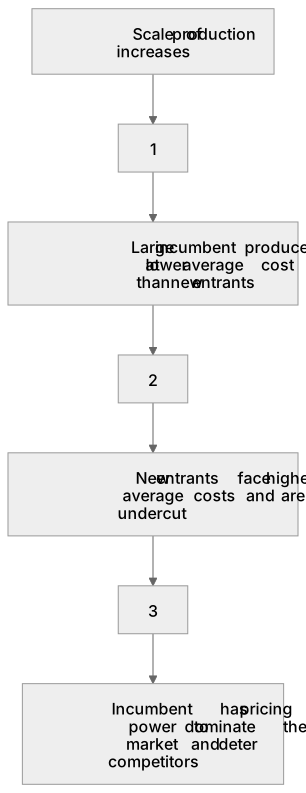
1Box 1
2Box 2
3Box 3
There is more to this lesson
The full lesson goes on to check your understanding and help you earn the marks. Create a free account to carry on, with your progress saved.
A week of Premium from your first lesson · Then the free plan continues · No card, no charge
Test your understanding of Barriers to entry: d) Economies of scale and their impact on cost and price
Active recall beats re-reading. Take an instant quiz now to test what you’ve learned and lock it into long-term memory.
A week of Premium from your first lesson · Then the free plan continues · No card, no charge